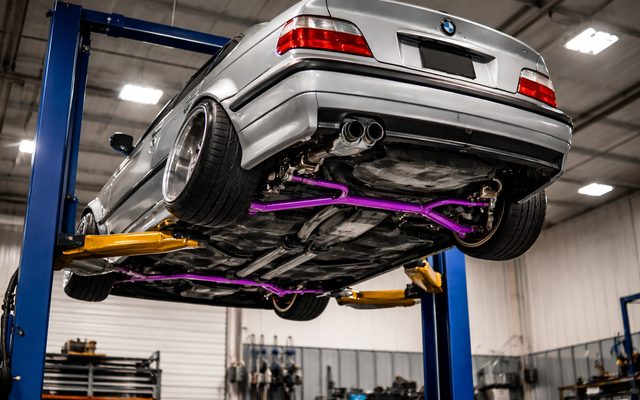
In the high-stakes arena of today's professional sliding, success is not merely solely a function of raw torque or pilot bravado. Rather, it has become a multifaceted discipline that requires a painstaking blend of selecting a time-tested vehicle platform, arming it with the highest-quality performance hardware, and, most essentially, comprehending its real-time characteristics on the circuit through cutting-edge suspension tuning applications. This definitive handbook acts as your blueprint from the initial concept of a drift build all the way to the last engineering-refined refinements that elevate a strong machine into a repeatable champion. We will thoroughly explore the precise engineering of car suspension tuning, showing how a advanced vehicle dynamics tool like precise measurement hardware eliminates approximation and delivers exceptional visibility into your car's actual behavior.
The cornerstone of any exceptional drift machine is, undoubtedly, the platform itself. Certain cars have achieved legendary status within the global sliding culture due to their built-in weight distribution, robust build quality, and the immense availability of aftermarket parts available. Picking the optimal car is the initial and most crucial choice a driver will make. For instance, the BMW E36 is widely regarded as perhaps the the finest overall drift cars of all time. Its near-perfect 50/50 weight distribution, alongside a RWD configuration and robust straight-six engines, creates a chassis that is simultaneously forgiving for newcomers and incredibly capable in the hands of a pro driver. The evolution of this lineage, the BMW E46, refines these attributes with a increasingly refined frame, broader wheel track for improved confidence, and yet more steering angle straight from the factory. Another formidable platform in the top-level arena is the Corvette C6.
This American track weapon brings a particular set of benefits to the sideways sport, such as a low-mass aluminum frame, a transaxle-style drivetrain component that contributes to an ideal front-to-rear mass ratio, and the tremendous thrust of a powerful GM LS engine. This combination makes it an utter force on track, capable of entering and holding extended slides with relatively easy deployment of acceleration. For drivers desiring remarkable performance per dollar, the Nissan Z33 rises above as a excellent candidate. It comes from the manufacturer with a robust chassis, a competent original LSD, and the smooth VQ series motor that delivers sufficient performance for mastering and moving up in the discipline. Its successor, the Nissan Z34, brings more advancements in chassis stiffness, suspension design, and peak engine power, cementing its position as a favorite pick among serious drivers. Further historic platforms that merit mention include the agile Wankel-engined Mazda FC RX-7, the ubiquitous Nissan S13, the American Ford SN95, the more recent E90 3 Series, and the tiny yet incredibly fun and forgiving MX-5 Miata. Each of these platforms provides a unique palette of attributes, difficulties, and capabilities, but they all have in common the basic ingredients essential to become a serious drift car.
However, selecting the correct platform is only the starting point. To access the full potential of every of these machines, substantial changes to the steering geometry and suspension systems are absolutely non-negotiable. This is where the realm of specialist aftermarket components comes into vital focus. The one most transformative modification for a purpose-built drift machine is the installation of a maximum-angle angle modification kit. These engineered systems, for example those developed by performance brands like SLR, are designed to radically increase the vehicle's available steering angle. A standard road car is highly restricted in how far its steering tires can pivot, a design trade-off for on-road use. In oversteer driving, but, maximum opposite lock is continuously required to catch and maintain a slide. An angle kit replaces the stock hubs, linkages, and potentially A-arms with pieces that permit the front tires to reach degrees of turn beyond 70 or even 80 degs, versus a typical factory angle of around 40 to 50 °.
This immensely expanded steering angle offers the operator with dramatically greater command during a drift, enabling it to be much simpler to initiate a drift, sustain it through a sweeping turn, and transition smoothly from one direction to another. The improvement in drivability is absolutely transformative. Paired with a correctly specified angle kit is the equally vital upgrade to the vehicle's spring and damper setup. Generic or even high-end street adjustable suspension are simply not designed for the unique and extreme needs of sliding. A dedicated system of suspension units is of utmost importance. These specialized coilovers have unique piston tuning and spring stiffness that are designed for the extreme mass transition that is characteristic of drifting. When a pilot starts a slide, the vehicle's inertia is thrown violently to the outside of the turn. Optimal performance coilovers control this shift in a controllable way, enabling the chassis to find its balance quickly and offering the pilot precise feel through the steering wheel and cockpit. They furthermore allow for exact adjustment of stance, rebound and compression stiffness, and corner weighting, which are all fundamental parts of optimizing the car's handling to a particular circuit or competition style. In combination, a precision-engineered steering angle kit and a correctly chosen system of competition adjustable dampers are the absolute mechanical foundation upon which all subsequent refinement is based.
Once the core hardware is in place, the subsequent essential step in the development is the meticulous adjustment of the chassis's alignment. This is the world of vehicle alignment optimization, a methodology that can appear daunting to the uninitiated but is, in fact, the key to converting a collection of high-performance pieces into a harmonious and controllable whole. The most critical element of suspension geometry for oversteer is undoubtedly negative camber. Camber is the angle of the tire in relation to the vertical plane when observed from the front-on of the car. If the top edge of the wheel is leaning towards the chassis, this is called camber-in. In sliding, an inward tilt on the front tires is widely used and is considered essential. The purpose is deeply related to vehicle dynamics.
When a vehicle is going around a bend at high sideways angles, the chassis tilts towards the outer of the corner. This chassis roll makes the outer front wheel to reduce its best footprint with the tarmac. By adding inward lean, the tire is pre-angled to compensate for this lean. As the vehicle rolls into the bend, the outside front tire becomes more upright on the asphalt, maximizing its grip at the exact point when it is most required for control. Commonly, front axle angles for a dedicated drift machine range from approximately -3 degrees to as extreme as -5 degrees or even more, depending on the specifics of the car configuration, tire selection, and pilot feel. The back tires also use inward lean, but the values are usually more conservative and more nuanced than the front. Too much negative camber at the back can result in the chassis extremely tail-happy and difficult to predict on power use, as it reduces the effective grip area of the driven tires during linear throttle application. Thus, rear camber settings are often in the range of -1 degree to -3 degrees, achieving a delicate balance between providing adequate lateral bite to help in initiating and sustaining the angle while still keeping good traction for power-down the bend. camber angle is just one part of the more complex suspension geometry puzzle, which also involves toe, caster, and suspension-induced steering adjustment.
Toe angle describes the angle of the tires when viewed from the top. Positive toe means the front edges of the wheels are closer together than the rear edges, while outward toe means the converse. For drifting, a modest amount of front axle toe out is commonly used to quicken the initial steering response, making the vehicle feel more agile and willing to begin a oversteer moment. Rear axle toe is usually set to zero or a incredibly slight amount of inward toe to foster straight-line stability under acceleration. self-centering is the frontwards or aft angle of the suspension pivot when observed from the side of the vehicle. Positive positive caster increases steering feel and stability solidity, and it additionally boosts negative camber gain during cornering, which is very beneficial. Setting these values is a complex interaction where a adjustment to one setting can and will affect the remaining parameters. The conventional process for setting a chassis's alignment for sliding has long been a time-consuming affair of guesswork and adjustment. A driver or team would introduce a change based on a hunch, drive the vehicle on track, depend on the operator's subjective perception and feedback, and then introduce another tweak. This loop would repeat time after time until the vehicle felt "right" or the scheduled practice session ended. This approach is not only extremely wasteful in terms of time and tires, fuel, and parts, but it is additionally inherently imprecise.
Driver feel is a notoriously subjective metric, influenced by numerous factors such as tiredness, changing track surfaces, temperature, and just the mood of the pilot on that specific run. What feels "oversteery" on one lap might feel "pushing" on the next lap, causing confusing information and counterproductive adjustments. This traditional problem in vehicle dynamics optimization is specifically where contemporary technology has intervened to revolutionize the landscape.
The rise and integration of advanced vehicle dynamics tools has brought about a completely new era for tuning and optimizing high-performance drift cars. This new generation of systems, represented by cutting-edge solutions like GripDial, operate by physically capturing the live physical movement of the vehicle as it is operated on the circuit. In contrast to relying on personal feedback, these systems collect objective information on essential variables such as damper compression and extension, wheel speed, acceleration forces, wheel angle, and driver input input. This collected telemetry is then analyzed by powerful applications that can graph and interpret the metrics in a actionable format. For the first time ever, engineers and crews can visualize precisely what the chassis is performing at each point of a slide. This function changes the entire chassis setup procedure. Consider the aforementioned task of optimizing the front camber for a given car. As an alternative to applying a change from -3 degrees to -3.5 degrees and then driving multiple runs to try and "perceive" a improvement, a telemetry system can give immediate and clear information. The software can display visually how the tire's loading is behaving during the most drift telemetry software important moments of a angle: turn-in, mid-corner, and changing direction. It can reveal if the current camber setting is allowing the steering tire to keep optimal loading or if the rubber is working inefficiently on its external shoulder.
The system can subsequently provide fact-based advice for change. Perhaps the data indicates that the outside front tire is even stressing its sidewall at -3.5 degrees of camber, implying that a move towards angle, say -4 degrees, might be beneficial. Conversely, the information might reveal that the tread is failing to reaching temperature or that the inside edge is wearing excessively, which could indicate that there is overly aggressive inward lean and a modest lessening back to -3.2 degrees would be more optimal. This standard of granularity and actionable insight was simply unimaginable in the days of solely seat-of-the-pants tuning.
The benefit of using a comprehensive drift telemetry system goes much further than merely optimizing camber angles. It functions as an invaluable damper adjustment manual that is tailored to your particular chassis. When adjusting the rebound and compression settings on your suspension, instead of using imprecise guidelines or copying another driver's settings, you can employ the data to analyze how the car is reacting in relation to your tweaks. The application can graph the wheel movement trace over a run, highlighting if the dampers are controlling the body movement properly or if they are allowing the vehicle to bounce uncontrollably after a flick. It can assist in pinpointing challenges like excessive compression or excessive extension, enabling you to apply educated choices to spring preload, damping values, or ride height. This process applies equally to the complex task of car alignment tuning. Beyond camber, the system can offer analysis into how changes to toe settings and caster angle are influencing the chassis's handling during various phases of a slide. For example, it can help you to determine the best amount of front axle toe out for your particular steering rack configuration and piloting style by analyzing the quickness of initial response and the stability of the chassis at full countersteer. This transforms the software an exceptionally useful drift suspension tuning guide that is constantly calibrated by the real-world performance of your own chassis on the track. It elevates the whole endeavor from a subjective skill into a scientific engineering procedure.
Additionally, the utility of a platform like GripDial is not confined to professional tuners with vast funding. For the amateur enthusiast, it acts as an powerful educational tool. It car suspension tuning effectively provides the driver with the insight of a professional race engineer without requiring the associated expense. It accelerates the learning curve by delivering clear solutions to problems that would otherwise take seasons of experimentation to answer. A driver can understand how their individual chassis behaves to different adjustments, developing a more intuitive knowledge of vehicle dynamics in the endeavor. It additionally democratizes professional performance tuning principles, allowing all drivers with the drive to perfect their car to achieve it in a structured and productive way. This is notably significant in a discipline like sliding, where engineering know-how has car alignment tuning in the past been a highly secretive advantage among elite teams. Today, that capability can be in the hands of any motivated enthusiast.
In the final analysis, the journey to constructing and tuning the ultimate competitive drift car is a comprehensive endeavor that perfectly blends time-honored hardware wisdom with 21st-century data technology. It commences with the wise selection of a proven platform, then built upon the integration of critical competition hardware like high-performance drift angle kits and expertly specified drift-spec suspension units. The journey then advances into the precision realm of car suspension tuning, where values like camber angle, toe, and caster are precisely set to match the vehicle's upgraded hardware and the pilot's specific needs. Finally, and what really separates the contemporary process from the traditional methods, is the integration of a advanced vehicle dynamics tool. This platform eradicates the guesswork and inefficiency of only feel-based tuning by giving empirical, actual information on how the car is truly functioning. It functions as an unparalleled diagnostic aid, a definitive coilover setup manual, and a comprehensive chassis development system. In unison, this integrated philosophy ensures that all component of the drift machine—from the selection of the platform to the last click on the coilover—is refined for ultimate performance on the circuit. It represents the complete progression of the sport of sliding, bridging mechanical driving skill with surgical suspension engineering to create the ultimate dominant cars attainable.